

Updated November 2026. For a complete introduction to mutual funds, see our guide to mutual funds for beginners.
Mutual funds have become one of the most widely used investment options for Indian households, and the amount invested through Systematic Investment Plans (SIPs) has grown many times over in the last decade. A SIP is not a product in itself. It is simply a method of investing in a mutual fund scheme: a fixed amount is invested on a fixed date every month, debited automatically from your bank account.
Because most SIPs are made in equity funds, which are market-linked, the value of your investment will rise and fall with the markets. Returns are not guaranteed and can be negative over short periods. Understanding what a SIP can and cannot do is therefore important before you begin.
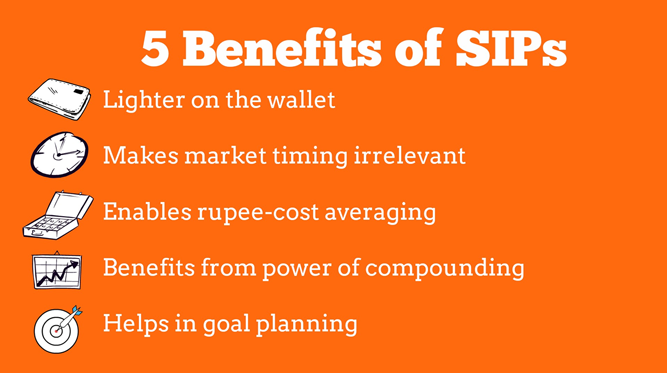
1. It builds a habit of regular investing
Once a SIP is registered, the amount is invested every month without any further paperwork. This turns investing into a routine, much like a recurring bill, and removes the temptation to postpone saving. For most salaried investors, this discipline is the single biggest benefit of a SIP.
2. It averages your purchase cost
Each instalment buys units at that day’s Net Asset Value (NAV). When markets are high, your fixed amount buys fewer units; when markets are low, it buys more. Over time, this spreads your purchases across market highs and lows. This is known as rupee cost averaging.
It is worth being precise about what averaging does. It reduces the risk of investing a large amount at an unfavourable moment, and it removes the need to time the market. It does not guarantee a profit, it does not protect against a loss in a falling market, and it does not ensure that you buy at the lowest possible price.
3. Time allows compounding to work
When returns are reinvested, they begin to earn returns of their own. The longer you stay invested, the larger this effect becomes, which is why starting early matters more than starting big.
As an illustration only, consider a monthly SIP of ₹1,000 at an assumed return of 12% a year:
| Period | Total invested | Illustrative value |
|---|---|---|
| 10 years | ₹1.2 lakh | about ₹2.3 lakh |
| 20 years | ₹2.4 lakh | about ₹9.9 lakh |
| 30 years | ₹3.6 lakh | about ₹35 lakh |
An investor who starts at 25 and continues for 30 years could accumulate about ₹35 lakh on these assumptions. An investor who starts at 35 and wants the same amount by 55 would need to invest about ₹3,500 a month, three and a half times as much, because the money has ten fewer years to compound. Actual returns will differ, and may be considerably lower.
4. It is flexible and affordable
Many schemes accept SIPs from a few hundred rupees a month. You can increase the amount as your income grows, either manually or through a step-up (top-up) facility, pause or stop the SIP, and redeem units from open-ended schemes when you need the money. Some schemes charge an exit load on redemptions within a specified period, and ELSS funds have a three-year lock-in.
SIP or lump sum?
Neither method is always better. In a market that rises steadily, a lump sum invested at the start usually ends up ahead, because more money is invested for longer. In a volatile or falling market, a SIP can do better because it buys more units at lower prices. For most people the choice is practical rather than strategic: savings from a monthly salary suit a SIP, while a large one-time sum, such as a bonus or maturity proceeds, can be invested at once or spread over a few months through a Systematic Transfer Plan (STP) if the investor is uncomfortable with timing risk.
What a SIP cannot do
- It cannot remove market risk. An equity SIP can show a loss, sometimes for a year or more.
- It cannot make an unsuitable fund suitable. The choice of scheme still matters.
- It cannot work if it is stopped every time markets fall. Discipline during downturns is what makes averaging effective.
- It is not a substitute for an emergency fund or adequate health and term insurance, which should come first.
Managing your SIP
SIPs can be started, modified, paused or cancelled online through the fund house, an investment platform, or the registrars CAMS and KFintech, as well as through the MF Central portal. Link each SIP to a specific goal, review your funds once a year, and invest only your own savings, never borrowed money.
Work out your own numbers: use our free SIP calculator and step-up SIP calculator. Results are illustrations based on the returns you assume, not guarantees.
Related reading: step-up SIPs: the power of a 10% yearly increase, guidelines for long-term investors, and types of mutual funds explained.
All figures are hypothetical illustrations at an assumed rate of return, before tax and expenses, and are not a forecast or promise of future performance. This article is for general education only and does not constitute investment advice. Mutual fund investments are subject to market risks. Please read all scheme related documents carefully before investing.

