

Updated November 2026 with current tax rules.
Indians have used life insurance as a means of saving for decades, ever since the Life Insurance Corporation of India (LIC) was established as the sole life insurer in 1956. The sector was opened to private insurers in 2000, and many private companies now compete with LIC. Traditional products such as endowment and money-back policies offer relatively low but largely predictable returns, and this simplicity still attracts many buyers. But life insurance is fundamentally a means of protecting income in case the primary earner dies before the dependants are financially independent; it is not an efficient savings or investment tool. With that in mind, let us look at the common types of life insurance and their advantages and disadvantages.
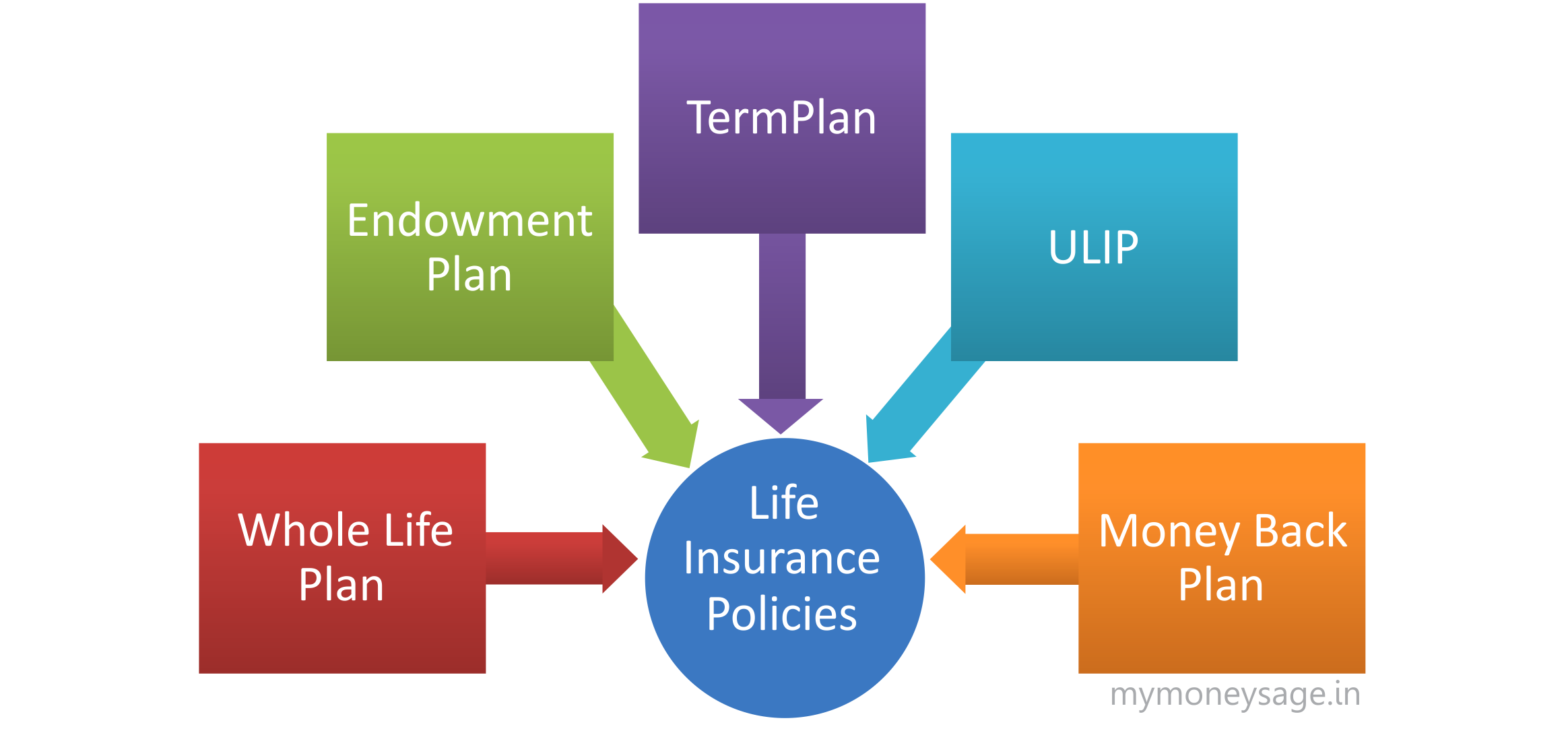
- Term Insurance: This is life insurance in its purest form. You pay a fixed premium every month or year for a chosen term, generally until retirement. Nothing is paid back if you survive the term, but if you die during the term, your nominees receive the sum assured. Because there is no savings element, the premium is a small fraction of what a savings-linked policy with the same cover would cost. The cover should be linked to your income and responsibilities; see our guide on how much term cover you need.
- Endowment Policy: This combines savings with insurance, which is rarely a good idea. It is usually better to buy term insurance for protection and invest the difference in premium separately according to your goals. Returns on endowment policies have historically been modest, and a large part of the premium goes towards insurance cost and charges. Bonuses are often presented attractively, but the effective return is usually comparable to safe fixed-income options. If premiums are stopped early, you may get back less than you paid, although IRDAI rules effective 1 October 2024 now require a special surrender value to be payable after the first policy year. The premium for a meaningful cover is far higher than for a term plan.
- Money Back Policy: Similar to an endowment policy, but it pays back a portion of the sum assured at fixed intervals during the term. Because money is paid out earlier, the overall returns are typically slightly lower than an endowment policy with similar terms.
- Whole Life Policy: Similar to an endowment policy, but cover continues for the whole of life (commonly up to age 99 or 100), and the sum assured is paid to the nominee on the policyholder’s death. Its objective is to leave an amount for the family even when they are no longer financially dependent on the policyholder.
- Unit Linked Insurance Plans (ULIP): A ULIP uses part of the premium for insurance and invests the rest in equity and debt funds chosen by the policyholder, who can switch between funds within set limits. ULIP charges have come down considerably since the reforms of 2010, but they still include premium allocation, policy administration, mortality and fund management charges. ULIPs have a five-year lock-in and are the life insurance product most comparable to mutual funds. For a detailed comparison, see mutual funds vs ULIPs.
Savings-linked insurance products generally carry higher costs than mutual funds, a large part of which goes towards distribution commissions in the early years of the policy.
Tax points to note: Premiums on individual life insurance policies have been exempt from GST since 22 September 2025. The deduction for premiums (Section 123 of the Income-tax Act, 2025, formerly Section 80C) is available only under the old tax regime. Maturity proceeds are tax-free only within limits: for ULIPs, if the annual premium exceeds ₹2.5 lakh, and for other policies issued from 1 April 2023, if the annual premium exceeds ₹5 lakh, the maturity proceeds become taxable. The premium must also generally stay within 10% of the sum assured. Death benefits remain tax-free.
Related reading: life insurance: what you need to know, and health insurance: what you need to know.

