
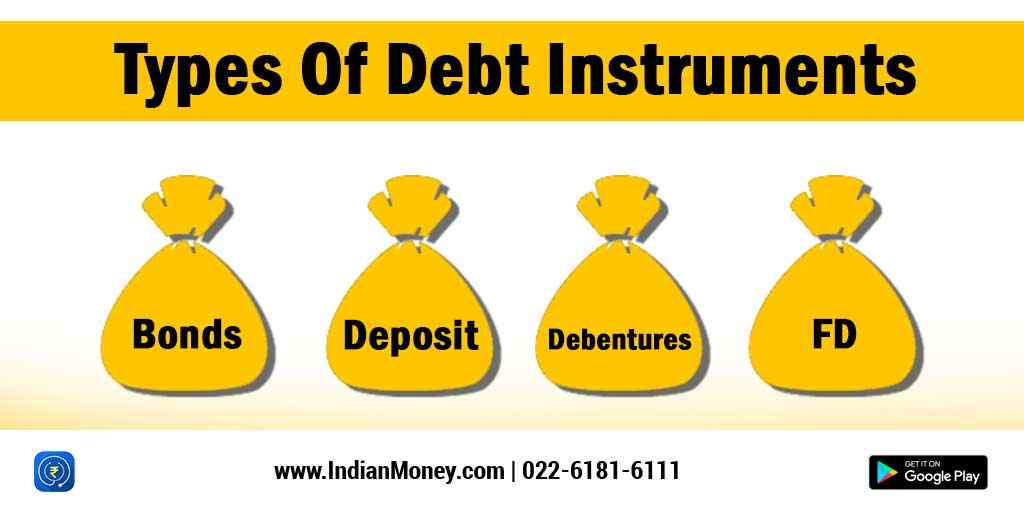

Debt refers to borrowing by the Government of India, State Governments, public sector organisations and private sector companies to raise money for their short-term and long-term needs. Debt instruments can be grouped as government debt and corporate debt, and as short-term and long-term debt.
The Government of India borrows money every year, largely from banks, insurance companies, mutual funds and other institutions, to meet its expenditure. It is the largest borrower in the country. State Governments also borrow through State Development Loans.
Short-term government borrowing, for less than one year, is done through Treasury Bills (T-Bills), issued with maturities of 91, 182 and 364 days. Treasury Bills form part of the money market, along with commercial paper issued by companies, certificates of deposit issued by banks, and call money, which is overnight lending and borrowing between banks.
Government borrowing for more than one year is done through Government Securities, also called G-Secs or gilts, with maturities ranging from a few years to as long as 40 years or more. Central Government securities carry practically no default risk, so they pay a lower coupon than corporate bonds of similar maturity, and they act as a benchmark for pricing other borrowings.
Corporate debt takes the form of debentures, bonds and corporate fixed deposits, while public sector undertakings typically issue bonds. Credit rating agencies such as CRISIL, ICRA, CARE and India Ratings assess the credit quality of these borrowings, with ratings ranging from AAA (highest safety) downwards.
Banks and financial institutions invest heavily in government and corporate debt. The RBI requires banks to hold a certain portion of their deposits in government securities (the Statutory Liquidity Ratio), and adjusts its policy tools to manage liquidity, inflation and growth in the economy.
Mutual funds and insurance companies also invest in debt. Debt mutual funds are classified by SEBI largely by the maturity and credit quality of what they hold: overnight, liquid, ultra-short, money market, short, medium and long duration funds, gilt funds, corporate bond funds and others. Funds investing in instruments of less than one year, such as liquid and money market funds, are generally used to park short-term money, while longer-duration funds are more sensitive to changes in interest rates. Open-ended debt funds can be redeemed on any working day.
Dividends from debt mutual funds are taxed in the hands of the investor at their slab rate, and gains on debt fund units purchased on or after 1 April 2023 are also taxed at slab rate regardless of holding period. Individuals can also invest directly in government securities through the RBI Retail Direct platform at rbiretaildirect.org.in.
Updated November 2026.
Related reading: how to choose debt-based mutual funds, and mutual fund taxation explained.

